China Top 10 Beer Pong Game Manufacturers for Buyers

Choosing a Beer Pong Game supplier takes more than comparing prices. Buyers need consistent cup dimensions, stable ball bounce, clean printing, and packaging that survives shipping. For manufacturers, small details matter: a warped table edge or loose-fitting cup can spoil a game night. Fit matters.

There is no widely recognized public report measuring the Beer Pong Game market alone. Broader market data offers context, not a precise forecast. Grand View Research’s board-games market report estimated the global market at about US$12.4 billion in 2023, reflecting demand across a much wider category. That figure should not be treated as Beer Pong Game sales. It does, however, underline why buyers should check product quality and supplier capacity rather than rely on market-size claims.

Game-design scholars Katie Salen and Eric Zimmerman define a game as “a system in which players engage in an artificial conflict, defined by rules, that results in a quantifiable outcome.” Their framework helps explain why simple, repeatable play depends on clear rules and dependable equipment. This guide examines ten China-based manufacturers through practical buying criteria: materials, customization, production consistency, sample quality, and communication. Ask for a physical sample. Compare it with the specification. A supplier’s catalog may look polished, but real-world performance can differ. That gap deserves attention.
China Top 10 Beer Pong Game Manufacturers for Buyers

What Beer Pong Games Are and How They Are Manufactured in China

Beer pong games are social tabletop kits built around lightweight cups, small balls, and a playing surface. Some sets include folding tables, printed layouts, or carry bags. In China, production often begins with material selection and mould design. Cup makers test wall thickness, rim smoothness, and stackability. Table suppliers check hinges, surface printing, and resistance to repeated handling. Small details matter. A rough cup rim or a warped table can spoil play.

The material choices reflect a wider manufacturing challenge. The OECD’s Global Plastics Outlook reports that global plastics production reached 460 million tonnes in 2019; this figure covers all plastics, not game products. China’s National Bureau of Statistics reported 74.885 million tonnes of plastic-product output in 2023. These figures provide industrial context, not a measure of beer pong production.

A typical quality workflow may include incoming-material checks, sample assembly, print inspection, and carton-drop testing. Buyers should request measurable specifications, such as cup capacity, table dimensions, and packing weight, rather than relying on photos alone. Ask for test records. They can still miss real-use problems. A practical sample review should include stacking cups, unfolding the table several times, and checking whether printed markings stay clear under indoor lighting.
China’s Beer Pong Game Manufacturing Market and Product Categories

China’s beer pong game manufacturing market is better understood through product categories than headline market-size claims. The National Bureau of Statistics of China reported that manufacturing value added grew 5.0% in 2023. This offers useful industrial context, but it does not measure beer pong products specifically. Customs categories also do not neatly isolate complete beer pong sets. A key caveat.

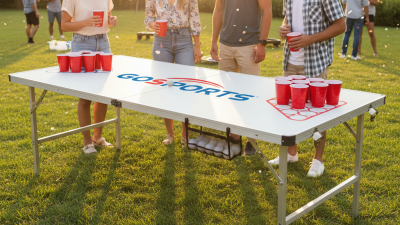
Suppliers commonly make folding tables, reusable cups, lightweight balls, carrying bags, and complete party sets. Table options may include printed surfaces, reinforced edges, and folding legs; buyers should check stability and surface finish, not just dimensions. Accessories such as cup racks and washable mats can be ordered separately or bundled. Materials, packaging, and print quality often vary between samples and bulk production. Details matter. The broad manufacturing data point is not a direct proxy for demand, factory capacity, or export performance in this niche. Buyers can compare samples, written specifications, and production tolerances before selecting a supplier. One imperfect point: product listings rarely reveal how consistently a factory can reproduce a custom design.

China Top 10 Beer Pong Game Manufacturers for Buyers – China’s Beer Pong Game Manufacturing Market and Product Categories

This table compares common beer pong product categories and manufacturing options available to buyers. It is a product-category guide, not a verified ranking of individual factories. Materials, dimensions, printing methods, and compliance documentation vary by supplier and should be confirmed before ordering.

Product Category Typical Construction Common Customization Options Suitable Buyers Key Sourcing Checks
1. Standard Cup-and-Ball Set Reusable plastic cups paired with lightweight ping-pong-style balls. Cup color, ball color, set quantity, printed packaging, and instruction inserts. Retailers, promotional-product distributors, and party-supply wholesalers. Confirm cup capacity, dimensions, plastic type, ball diameter, included quantities, and packaging details.
2. Foldable Beer Pong Table Portable tabletop, commonly built with a foldable frame and a printed playing surface. Table dimensions, surface graphics, edge design, frame finish, carrying handle, and carton artwork. Event suppliers, online retailers, and buyers seeking portable game equipment. Check assembled dimensions, folded dimensions, frame stability, surface finish, weight, and carton protection.
3. Regulation-Style Playing Table Long-format table designed around commonly used beer pong layouts; specifications vary between suppliers. Playing-surface artwork, cup layout markings, table finish, frame configuration, and packaging. Specialty game retailers, bars, and event or tournament organizers. Request a dimensioned drawing and sample; do not assume that “regulation-style” means one universal standard.
4. Tabletop or Mini Beer Pong Set Compact cups and balls intended for a smaller playing area than a full-size table. Mini-table format, cup count, colors, printed graphics, and gift-box design. Gift shops, party retailers, and buyers looking for compact products. Verify the complete set contents, finished size, age grading, and whether the product is intended as a toy or party game.
5. LED-Lit Cup Set Plastic cups with integrated or detachable lighting components, depending on the design. Lighting colors, activation method, cup colors, retail packaging, and artwork. Party-product retailers and event businesses seeking illuminated accessories. Confirm battery type, battery inclusion, operating instructions, electrical safety documentation, and applicable import requirements.
6. Custom-Printed Cup Set Plastic game cups printed with buyer-supplied graphics or text. Print colors, print area, logo or artwork, cup color, order quantity, and packaging. Promotional campaigns, private-label programs, and event merchandise buyers. Approve a production sample, confirm print durability and artwork ownership, and check whether printed cups are intended for food contact.
7. Ball Refill Pack Replacement lightweight balls supplied separately from cups or tables. Ball color, pack quantity, printed pouch or box, and color assortment. Retailers, game-set assemblers, and buyers replenishing consumable accessories. Confirm diameter, material, roundness, quantity tolerance, and packaging protection against deformation.
8. Complete Party Kit A bundled set that may include cups, balls, rules, and selected game accessories. Bundle contents, cup and ball colors, instruction language, inserts, and retail-box design. Party-supply stores, e-commerce sellers, and seasonal gift buyers. Use a signed bill of materials to verify every component, quantity, language, and packaging specification.
9. Outdoor or Event-Use Set Portable game components selected for setup and transport at indoor or outdoor events. Carry bag, table format, cup colors, weather-conscious packaging, and event graphics. Rental companies, event organizers, and outdoor recreation retailers. Ask suppliers about surface-care instructions, transport durability, water exposure limits, and replacement-part availability.
10. Private-Label Retail Set A buyer-specified combination of standard game components packed under the buyer’s own packaging design. Component selection, color matching, packaging artwork, barcode placement, and instruction materials. Importers, retail chains, and online sellers developing their own product lines. Confirm minimum order quantity, sample approval process, production lead time, inspection criteria, and required market-specific documents.

How Buyers Can Evaluate Beer Pong Game Manufacturers

When comparing beer pong game manufacturers in China, buyers should look beyond catalog photos. Request a physical sample and check the table surface, folding legs, edge finish, and cup markings. Small defects matter. A table that wobbles on a flat floor can frustrate players, even if its printed design looks sharp. Ask for the product’s open dimensions, folded size, weight, and packing details. These figures help confirm whether the game suits your sales channel and shipping plan.

Evaluate quality control with specific questions. How are print alignment and color consistency checked? Are tables inspected before packing? Ask whether production samples can be compared with finished goods. Review the stated order quantity, production timeline, customization options, and replacement process in writing. Clear answers are useful. Vague promises are not. One easy mistake is choosing a supplier based only on a low quote; packaging, sample fees, or inconsistent finishes may change the real cost. A factory visit or independent inspection can add confidence, though neither guarantees every unit will be perfect. Keep records of approved samples and specifications. It is a little extra work, but it can prevent avoidable surprises.

How Buyers Can Evaluate Beer Pong Game Manufacturers

Suggested buyer evaluation weights (%) for comparing manufacturers. These are planning guidelines, not survey results; adjust them to your product requirements.

Prioritize product quality and safety, then assess customization, production capacity, compliance documentation, pricing, and delivery reliability. Verify each factor with samples and written supplier documentation.

China’s Top 10 Beer Pong Game Manufacturers for Buyers

China’s Top 10 Beer Pong Game Manufacturers for Buyers

Choosing a manufacturer takes more than comparing unit prices. Buyers should check cup dimensions, ball bounce, print durability, packaging strength, and sample consistency. A useful shortlist includes factories that explain material choices and provide clear quality-control records.

Market data offers context, not a direct forecast for beer pong sets. Grand View Research estimated the global board games market at US$12.1 billion in 2023, with projected annual growth of 4.5% through 2030. Its report does not isolate beer pong products. Circana reported that U.S. toy sales fell 8% in 2023, a reminder that wider play markets can shift. These figures support careful demand planning, not automatic sales assumptions.

Ask shortlisted suppliers for recent production samples and written specifications. Check whether cups stack without sticking, balls retain a consistent shape, and printed surfaces resist light rubbing. Small details matter. Compare carton dimensions and protective inserts, too; damaged packaging can erase a low-price advantage. A factory’s polished sample may not represent every production run, so request photos or inspection records from finished batches. No scorecard is perfect. Buyers should revisit supplier claims against physical samples before placing a large order.

How to Compare Suppliers, Request Samples, and Place an Order

When comparing China-based beer pong game manufacturers, start with a written specification, not a catalog photo. List cup material and capacity, ball diameter, table dimensions, printing method, carton count, and acceptable color variation. Ask each supplier for the same sample set and quote. Details matter. Inspect rim finish, wobble, odor, print alignment, and whether cups nest without sticking. Request a pre-production sample and compare it with a signed specification. Keep photos and measured dimensions. Deloitte’s 2024 Smart Manufacturing Survey found that 86% of respondents expected smart manufacturing to drive competitiveness within five years. That makes inspection records and production traceability worth asking about, not just low prices.

Compare sample quality, minimum order quantity, unit price, tooling fees, lead time, payment schedule, and shipping terms in one table. Request a dated sample invoice and confirm who pays courier charges. The World Bank’s 2023 Logistics Performance Index assessed 139 economies across areas including customs, infrastructure, tracking, and timeliness. Use those factors to test delivery promises: ask for carton dimensions, gross weight, and dispatch milestones. Ask for photos of packed cartons. Small checks prevent costly surprises. One weakness in my checklist: phone-screen colors can mislead, so approve a physical swatch. Before a trial order, confirm defect remedies and re-order consistency in writing.